
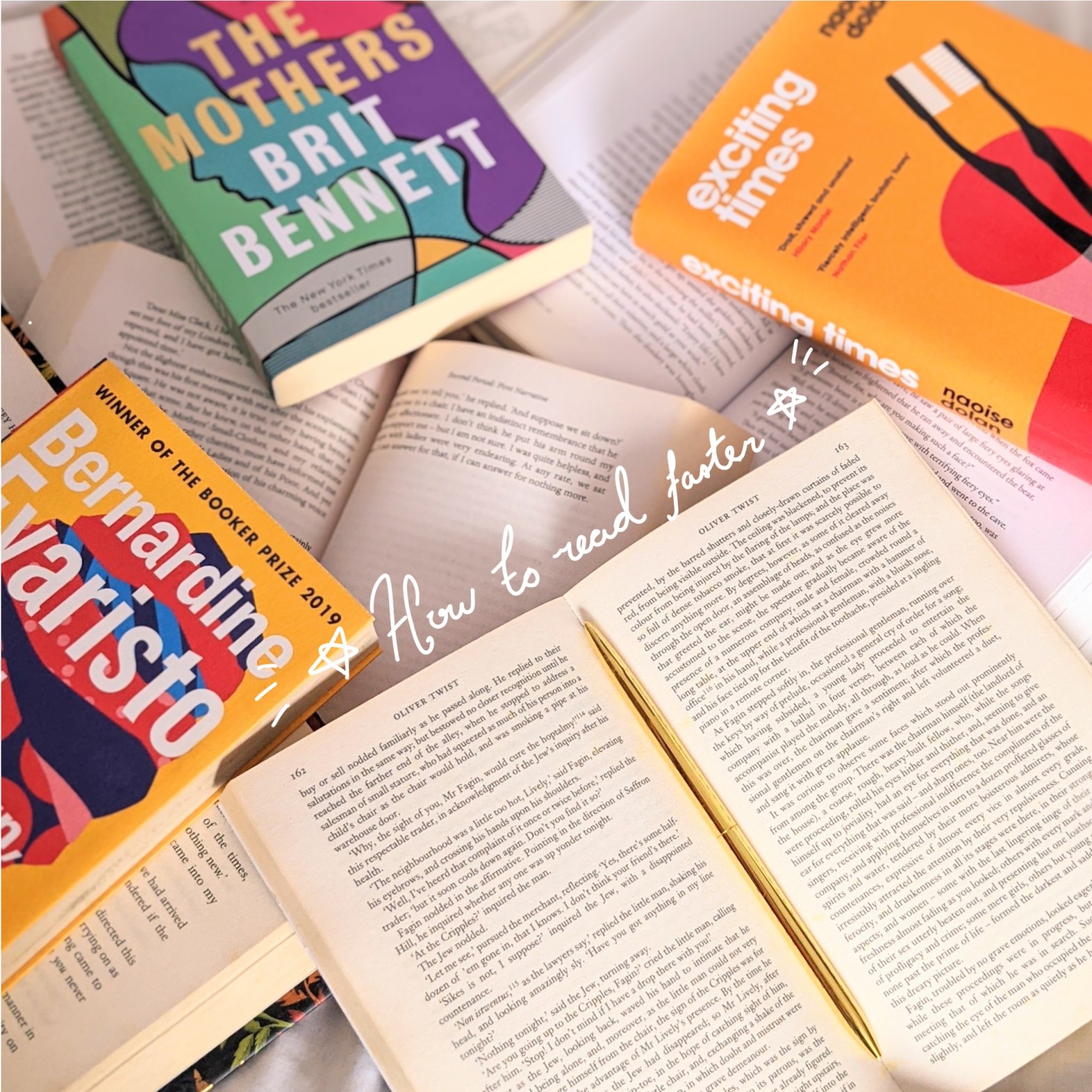
Whether you have a reading list the size of Everest or want to read more books to entertain yourself and enrich your mind, reading faster can be a great skill to have.
You can start by training yourself to read more efficiently. You will need to improve both how you read and how often you read to see a decent improvement. The tips in this post will cover both aspects and hopefully assist you on your journey to faster reading!
During university, I would often have to read multiple books a week and made use of the techniques below to get through them. In my own time, I tend to read quite slowly, averaging about 2-3 books a month, but by implementing the practices below again, I was able to bring that up to 4-5 books.
1. Skim read
Skimming is a good way to get a quick overview of any article or book. It’s a useful method to decrease your reading time if you only need to establish the general argument of a piece of writing rather than if you’re reading for depth. Ensure that you grasp the basic information in each paragraph, as it can be disastrous if you skim read something and miss crucial aspects.
2. Spend more time reading
This might sound obvious, but if you only read for ten minutes in a day, you are hardly going to get through much over a long time. Try to read in spare moments where you might usually end up going through your phone. Some people read while they brush their teeth, eat their breakfast or on their daily commute. Ideally you should set time aside, half an hour plus is optimal, but if you have a busy schedule, trying to fit in reading whenever you can will greatly improve the speed at which you get through books. Though I read when I can throughout my day, I often reserve the last half an hour before I go to sleep for reading.
3. Choose your reading environment wisely
When you know you cannot focus or retain much information if you, for example, read on the train, you should avoid doing it. Choosing to read in the wrong environment can cause you to read slower, not only because you may find yourself reading the same sentence over and over but also because you may not be able to concentrate for long enough to get more than a page read and it will not be very productive.
Try to figure out what works best for you. If that is complete quiet and solitude, then make sure you seek out this kind of environment when you plan to read. Alternatively, you might like to listen to music while you read, whether it’s classical or otherwise, to block out any background noise.
4. Follow your finger
You may feel like a child doing this but following your finger or even placing a bookmark underneath lines as you read them can increase your reading speed. It will keep your eyes from jumping back to previous sentences and instead make sure you focus on what is ahead. Sometimes, with the fast pace of life, we need a little bit of help to slow down and concentrate and following your finger as you read can be beneficial.
5. Listen to the audiobook on x2 speed
I know a lot of people discredit audio books as a form of ‘reading’, but if it works better for you, then you should take advantage of being able to listen to stories. It helps in a similar way to following your finger but it’s harder to go back. An audio book will keep moving forward without you having to break concentration to turn a page. It’s a great way to fit in more reading if you don’t have much time to sit and stare at words, and adjusting the pacing means you can read books even faster than you would by yourself because you are not limited by the speed of your own internal monologue. There’s also the benefit of being able to multi-task. You can listen to an audio book while you cook, clean, or even while walking which will increase the amount of time you can spend reading.
6. Improve your vocabulary
Tripping up on words you don’t know will always slow you down. Reading widely will help to improve your vocabulary and reduce the number of words you don’t understand whilst reading, which will in turn increase your reading speed.
7. Read things that are more challenging
This one goes hand in hand with increasing your vocabulary. The first time I set my eyes on an academic paper I felt like it was written in a different language. Over time, however, I learnt how to understand it… or at least some dialects. The more you read language that is initially difficult for you, the better you will get at reading things that are relatively easier and so you will be able to read faster too.
8. Practice
This is another suggestion that sounds obvious, but once again practice makes permanent, even with reading. If you practice reading quickly and efficiently in a way that ensures you still take in what you are reading, you will improve over time and hopefully get through all the books you want or need to.
Always remember that even though it can be great to read a lot, the quality of your reading is probably more important. What’s the point of reading 50 books if you can’t remember anything about them, or if you had to skim them all to read that many? Take your time to read if you have it and if you don’t, you can use these tips to quickly get the most out of your reading.
I hope these tips help you to improve your reading speed. If you have any suggestions I have not mentioned, why not let me know?
 Read 'N Riot