
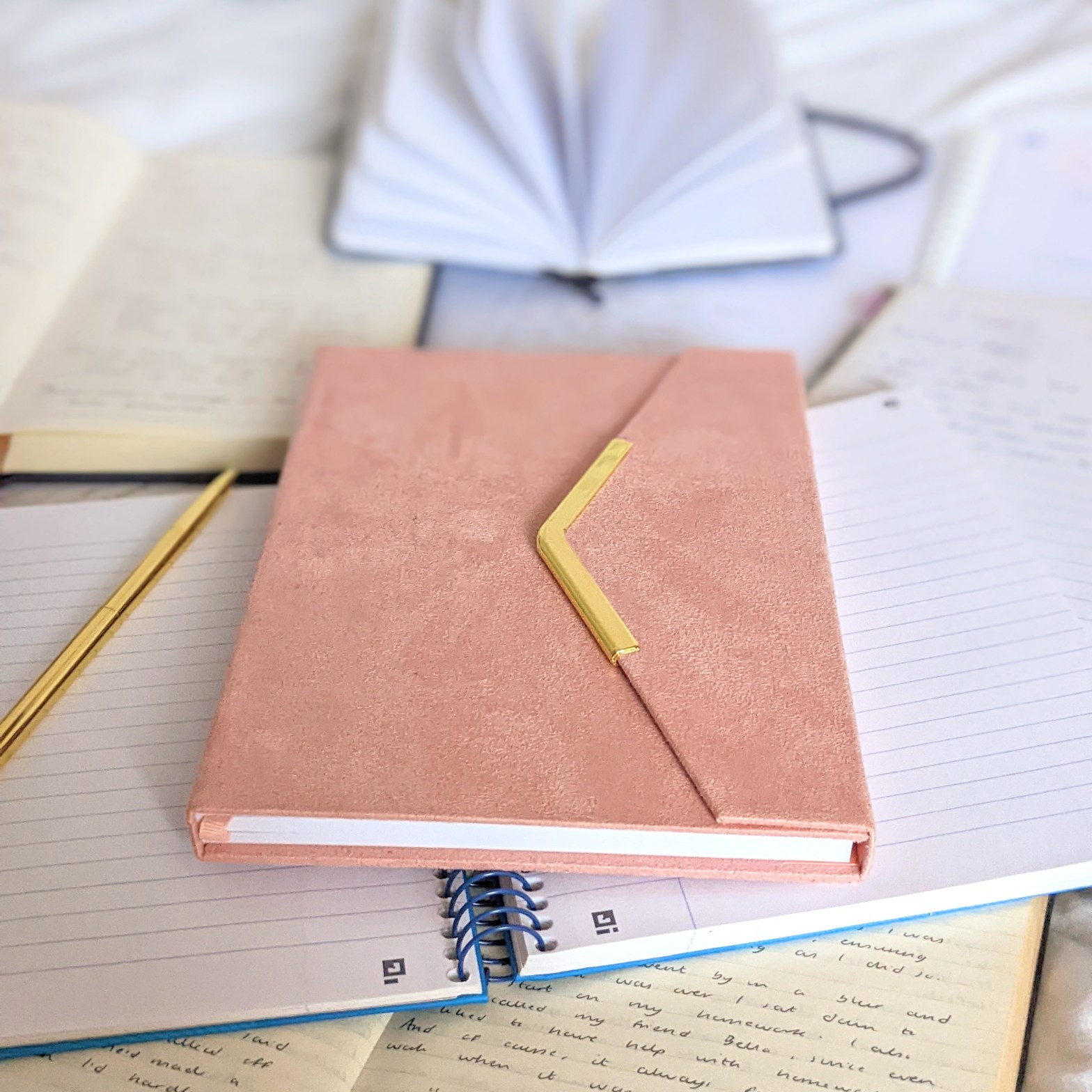
Notebooks are your unjudgmental friends. They’re a silent partner in creation, allowing you to freely consider your thoughts and ideas and cringe at them later. Notebooks merely watch as some ideas sink and others float, only to resurface later looking renewed, and their unbiased acceptance is exactly what you need to organise your writing life.
Like the blank page of a new word document, the first page of a fresh notebook can be intimidating. Maybe you often purchase gorgeous notebooks without considering the fear you might face in making your first potentially hideous mark in them. Or maybe you’re unsure about what project or topic to assign to any given notebook. I’m here to tell you that neither of those things really matter, and that as long as there are words, or even doodles, in your notebook, you’re doing something right.
I like to think that I’ve managed to eradicate my fear of starting something new when it comes to writing (in fact starting is usually the easy part, it’s finishing that’s the problem) and I’d like to offer some tips on how you might make use of any old or new notebooks you have laying around.
How You Should Use Notebooks as a Writer
Notebooks can be useful at every stage in the writing process. To use notebooks effectively as a writer, you can incorporate them into your learning, planning, writing and editing. Here are 5 ways you can use notebooks as a writer:
Research/Notetaking
If you’re afraid of scribbling your own words or ideas into a notebook, start by using it to collate information. Write down your favourite quotes from books you love or pick apart one of your favourite scenes. Take notes on the craft of writing. The internet has so much information that you’re bound to stumble across something that will be useful to you if you look.
Your notebook should be an extension of your mind, and there’s no reason why it cannot house the inspiring ideas of others until you’re comfortable enough to value your own too.
Planning
If there’s anything I’ve learned over my years of writing, it’s that for me, even a hastily put together plan is better than no plan at all. Maybe you don’t use plans, but if you’re not sure where you fall on the to plan or not to plan scale, try writing out the ideas you have for a short story or novel before you try to draft a coherent piece.
Working through your ideas before you bring them to a final document can help you pinpoint any weak points or problems before you get to writing and prevent writer’s block, which is usually a problem rooted in a lack of direction and can lead to a lack of motivation.
Practice
Fear may be for the blank page, but you can postpone that fear by starting in a notebook, which will never be blank if it’s lined, right? It can be so helpful to gain your footing in a private notebook before taking your writing to something more serious or organised. Hand-writing your notes can also slow you down a little bit and give you time to think about what you’re writing unlike the judgy blinking cursor of word processors.
Put the good, the bad, and the ugly in your notebook. You never have to look at it again if you don’t want to. But it is invaluable to have somewhere to work on things you might not be so good at, whether that’s dialogue or description. Working in bite-sized pieces that you can correct more easily before you move on will help you immensely in the long run.
Poach your old ideas or Reflect
I know I just said you don’t have to look back at your ideas if you don’t want to, but you also shouldn’t rule out old ideas completely. If you write everything down somewhere, it gives you the perfect opportunity to use what works and leave behind what does not as time passes. I may look at an old idea and repurpose it for something else or wonder how little sleep I’d been running on that I thought my rambling made any sense. You never know what will come in handy later.
Another thing you can try is noting down changes you want to make to things you might be working on as they come to you. Even though I said you can ignore whatever you’ve written before, it can be good to double-check that you’re making any progress on the points you wanted to.
Play around with new ideas
Maybe you dream up a new character or have an idea for a perfect setting. In your notebook, you can weave together all your random ideas and see how well they work, if at all. The great thing about a notebook is that whatever you put in it is like a sketch, it’s only the base layer of something great to come and you still have the time and space to easily change anything that does not look right.
If I haven’t made it clear enough already, I love notebooks. There is nothing better than pouring the contents of your brain into something that will never forget it and being able to track the process as hastily scribbled bullet points become a 50,000-word novel, or something.
I hope my words inspire you to open that notebook you got years ago and make your first mark or at the very least gave you something to think about. Maybe your thoughts can’t wait to be put down and tucked into the pages of a new notebook now.

 Read 'N Riot